Reflecting on 50 Years of Maintenance Management with MCP
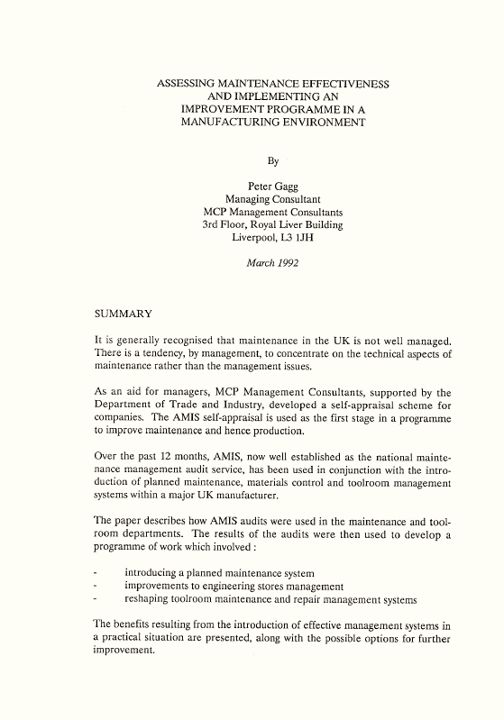
As MCP celebrates 50 years of supporting industry, we recently uncovered an interesting piece of company history - a technical paper written by our CEO, Peter Gagg, in 1992.

As MCP celebrates 50 years of supporting industry, we recently uncovered an interesting piece of company history - a technical paper written by our CEO, Peter Gagg, in 1992.
Titled “Assessing Maintenance Effectiveness and Implementing an Improvement Programme in a Manufacturing Environment”, the paper explored the challenges facing UK manufacturing and maintenance teams more than three decades ago.
Reading it today raises an important question:
Have maintenance challenges really changed all that much?
At first glance, the industry looks completely different. We now have AI, predictive analytics, IoT sensors, digital twins, CMMS platforms, remote diagnostics and advanced asset management systems. Maintenance has become more digital, more connected and more data-driven than ever before.
But when we compared Peter’s 1992 paper with the findings of the 2026 MAINSTREAM UK Maintenance and Reliability Research Report, the similarities were striking.
In many ways, the same fundamental issues remain.

The Challenges Identified in 1992
Back in 1992, Peter’s paper highlighted a number of familiar problems within UK manufacturing:
Maintenance strategies focused almost entirely on breakdown response
Preventive maintenance was poorly developed
Production teams were reluctant to release equipment for planned work
Planning and scheduling processes were ineffective
Stores and spare parts systems lacked control
Maintenance was rarely discussed strategically at board level
Training and workforce development were inconsistent
Production and maintenance teams operated in conflict rather than collaboration
The paper stated:
“It is widely recognised that in the UK maintenance management is not as effective as it needs to be and in fact attitudes have changed little in the last 20 years.”
Even more interestingly, the proposed solutions in 1992 would still sound entirely relevant today:
Planned and preventive maintenance
Failure mode analysis
Work planning and control
Materials management systems
Performance monitoring
Reliability-focused maintenance strategies
Structured maintenance audits and assessments
The technology available at the time was obviously very different — but the principles were remarkably familiar.
Fast Forward to 2026
Now compare that to the findings published in the 2026 MAINSTREAM UK research report.
The report identified twelve major obstacles preventing organisations from achieving maintenance and reliability excellence, including:
Reactive maintenance culture
Skills shortages
Poor work planning and scheduling
Lack of strategic asset management thinking
Weak operations and maintenance alignment
Poor data quality
Leadership buy-in challenges
Failure to sustain improvement programmes
Overreliance on technology without fixing fundamentals
The statistics are particularly revealing:
55% of UK maintenance budgets are still spent on reactive activities
76% of organisations still view maintenance primarily as a cost centre
83% of maintenance improvement initiatives fail to sustain results beyond 18 months
78% have no documented long-term asset management strategy
Perhaps most tellingly, the report concluded:
“The profession is not primarily constrained by technology, methodology, or budget. It is constrained by the ability to build and sustain cultures that consistently apply what is already known to work.”
That statement could easily have been written in 1992.
The Technology Has Changed - The Fundamentals Haven’t
That is not to say the industry has stood still.
Maintenance teams today operate in a far more advanced technical environment than they did thirty years ago. Modern organisations have access to:
Predictive maintenance technologies
Real-time monitoring
Advanced CMMS and EAM platforms
Reliability analytics
AI-powered diagnostics
Asset management frameworks such as ISO 55000
Mobile workforce solutions
Smart sensors and connected assets
But technology alone has never been the answer.
Interestingly, Peter Gagg explored this same theme in a presentation delivered in 2016 titled “Is the Past the Future for Maintenance?” — a question that feels even more relevant today.
The presentation highlighted issues including:
Lack of maintenance strategy
Poor use of software systems
“Lots of data but no information”
Poor planning and recording systems
Skills shortages
Weak spare parts data and coding
Misalignment between maintenance and business objectives
Again, all themes that still dominate modern industry discussions.
The Real Difference Between Success and Failure
After 50 years of working with organisations across manufacturing, utilities, transport, facilities management and heavy industry, one thing remains consistently true:
The organisations that achieve long-term reliability success are rarely the ones with the newest technology alone.
They are the organisations that consistently get the fundamentals right.
They:
Build proactive maintenance cultures
Invest in workforce skills and development
Align operations and maintenance teams
Use planning and scheduling effectively
Treat maintenance as a strategic business function
Make decisions using reliable data
Focus on long-term asset management, not short-term firefighting
Technology enables improvement.
Culture sustains it.
Looking Forward
As MCP celebrates its 50th anniversary, reviewing these documents has provided a fascinating reminder that while the industry continues to evolve, many of the core principles of maintenance excellence remain unchanged.
The terminology may have evolved.
The tools may be smarter.
The software may be more advanced.
But the organisations achieving the best results today are still the ones mastering the same fundamentals that mattered in 1992:
planning, reliability, collaboration, leadership, skills and continuous improvement.
Perhaps the past is not the future.
But there is still a great deal the future can learn from the past.