Does Every Asset Need a FMECA?
Discover how asset importance, equipment criticality and REM can help optimise maintenance strategies.

Does Every Asset Really Need a FMECA?
Failure Modes, Effects and Criticality Analysis (FMECA) is widely recognised as one of the most effective tools for improving asset reliability. It provides a structured approach to understanding how equipment can fail, the consequences of those failures and the maintenance strategies needed to reduce risk.
Because of its reputation, many organisations assume that carrying out a FMECA is always the right next step.
But is it?
In our experience, not necessarily.
It's not uncommon to see organisations applying the same level of engineering analysis across every asset, regardless of its importance or criticality. While the intention is to improve reliability, this approach can consume considerable time and engineering resource without always delivering the greatest return.
The objective shouldn't be to carry out the most detailed analysis possible. It should be to apply the right level of analysis to the right assets.
Start with Risk, Not the Methodology
Before deciding which reliability methodology to use, it's important to understand two things:
1. How important is the asset to the business ?
2. What are the consequences to the business if it fails?
An asset that presents significant safety, environmental, operational or financial risk deserves a different level of attention to one that has little impact on production or business perfomance or can easily be repaired or replaced.
Understanding asset importance and equipment criticality allows maintenance teams to prioritise engineering effort where it will deliver the greatest benefit.
High-Criticality Assets
Where an asset failure could have serious consequences for the business, a detailed FMECA is often the most appropriate approach.
These are typically the assets that have the greatest influence on safety, production, quality, environmental compliance or business continuity.
A structured FMECA helps organisations understand potential failure modes, assess their consequences and develop maintenance strategies that reduce risk and improve reliability.
The investment in time and engineering resource is justified because the consequences of failure are so significant.
Medium-Criticality Assets
This is where engineering judgement becomes important.
Not every medium-criticality asset warrants the time and resource involved to complete a comprehensive FMECA. In many situations, a targeted FMECA focusing on known failure modes, or a high-level Review of Existing Maintenance (REM), can deliver greater value for less effort.
The decision should be based on operational experience, maintenance history, failure data and business risk rather than applying the same methodology across every asset.
Lower-Criticality Assets
For assets with a lower operational impact, a Review of Existing Maintenance often provides greater value than using FMECA.
Rather than asking:
"How could this asset fail?"
REM asks a different question:
"Is the maintenance we're carrying out still appropriate?"
Reviewing existing maintenance activities can identify opportunities to:
Remove unnecessary maintenance tasks
Optimise maintenance intervals
Eliminate duplicate activities
Improve task effectiveness
Reduce maintenance costs
Make better use of engineering resources
In many cases, these improvements can reduce maintenance effort while maintaining—or even improving—asset reliability.
Principles of Asset Management - IAM Certificate Training
IAM certified course in Reading, Solihull, on-site or online.

At MCP Consulting Group, we offer comprehensive Review of Existing Maintenance (REM) services designed to assess and enhance your current preventive maintenance strategies, aligning them with best practices and organisational goals.
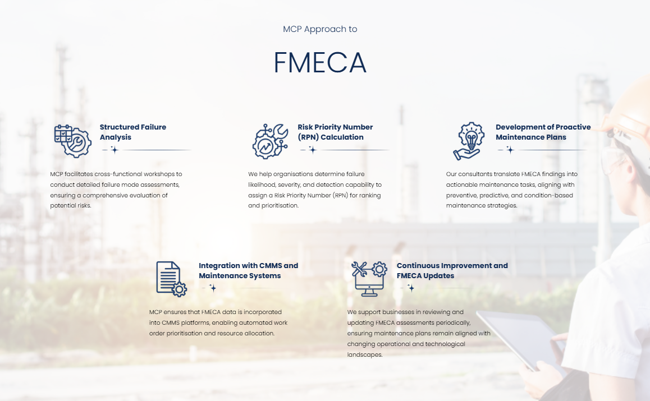
At MCP Consulting Group, we provide consultancy services in Failure Modes, Effects, and Criticality Analysis (FMECA) to help organisations develop a structured, risk-based approach to asset maintenance and reliability management.
Engineering Effort Where It Matters Most
Wrench time is typically measured through work sampling studies, technician observations, time tracking or maintenance productivity assessments. The objective is not to monitor individuals, but to identify process inefficiencies that prevent maintenance teams from spending more time carrying out productive work.
Typical Approach
Detailed level 2 FMECA analysis
Targeted level FMECA or high-level REM analysis
Detailed REM focused on maintenance optimisation
Asset Criticality
High
Medium
Low
The aim isn't to apply the same methodology everywhere. It's to ensure engineering effort is invested where it will have the greatest impact.
By matching the level of analysis to the level of risk, organisations can focus their most experienced engineers on the assets that genuinely require detailed investigation, while identifying more efficient ways to manage lower-risk equipment.
The Bottom Line
FMECA remains one of the most valuable tools available for improving reliability, but like any methodology, it delivers the greatest value when applied appropriately.
Understanding asset importance, assessing equipment criticality and selecting the right level of analysis enables organisations to make better use of engineering time, improve maintenance strategies and focus investment where it will have the greatest impact.
Successful maintenance isn't measured by the number of FMECAs completed. It's measured by improved reliability, reduced risk and maintenance strategies that deliver real business value.